
SQ-SE 8100: The Polyurethane-35 Film Former That Makes Peel-Off Masks Pain-Free
When was the last time you actually enjoyed using a peel-off mask?
If you're like most people, the answer is probably "never." The typical routine: slather it on, wait forever for it to dry, and then comes the moment of truth — you peel, and it feels like your whole face is coming off with it. Your blackheads stayed put. Your baby hairs? Gone. Your skin? Red, burning, and angry. And to top it off, the mask didn't even peel cleanly. Half of it crumbled into sticky little bits that you had to scrape off with your fingernails.
Dermatologists have been saying it for years: every single peel is essentially micro-trauma for your skin. The peeling motion disrupts the skin barrier, leading to irritation, inflammation, and in some cases infection.
It's not the "peeling" part that's the problem — it's the film former.
It's not really the "peeling" action that's the issue. It's the film former.
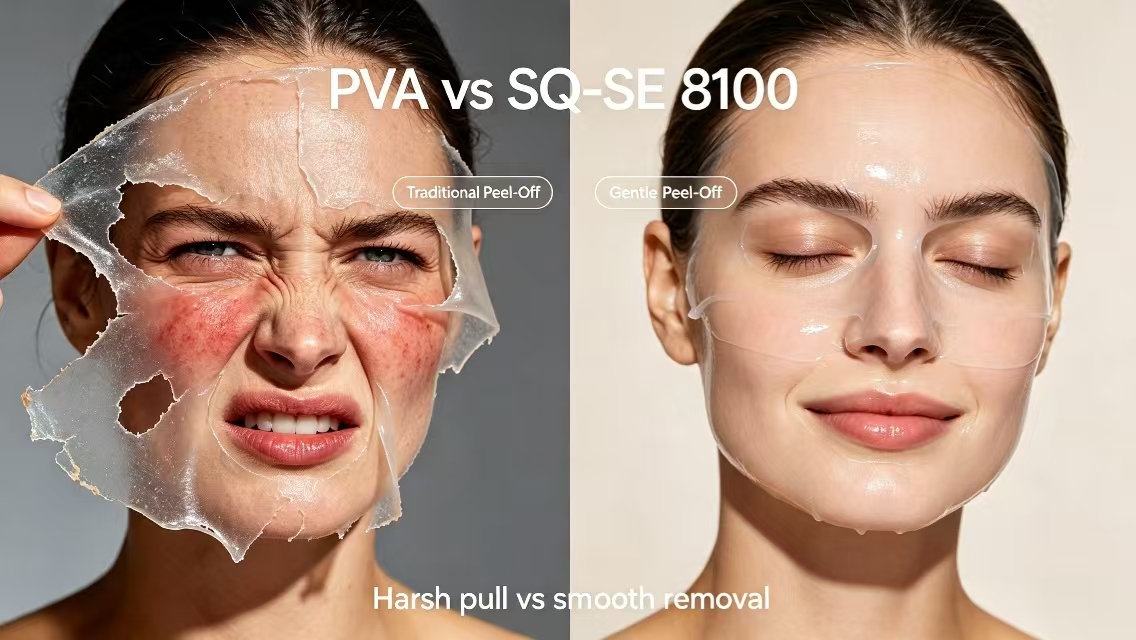
Traditional peel-off masks rely on polyvinyl alcohol — PVA. You know what else uses PVA? White glue. Industrial adhesive. Once it dries, it's stiff, brittle, and has zero give. Peeling it off means tearing it off — pure brute force. The stratum corneum gets ripped away, and your skin barrier pays the price.
To make it worse, alcohol is often added to speed up drying. Toss in some synthetic fragrances and dyes, and sensitive-skin users wouldn't touch it with a ten-foot pole. That's how peel-off masks earned their bad reputation.
SQ-SE 8100 (Polyurethane-35) changes everything. It's not a "new and improved" version of PVA — it's a completely different approach to film formation.
A SQ-SE 8100 (Polyurethane-35) Film Former That Redefines Peel-Off Masks
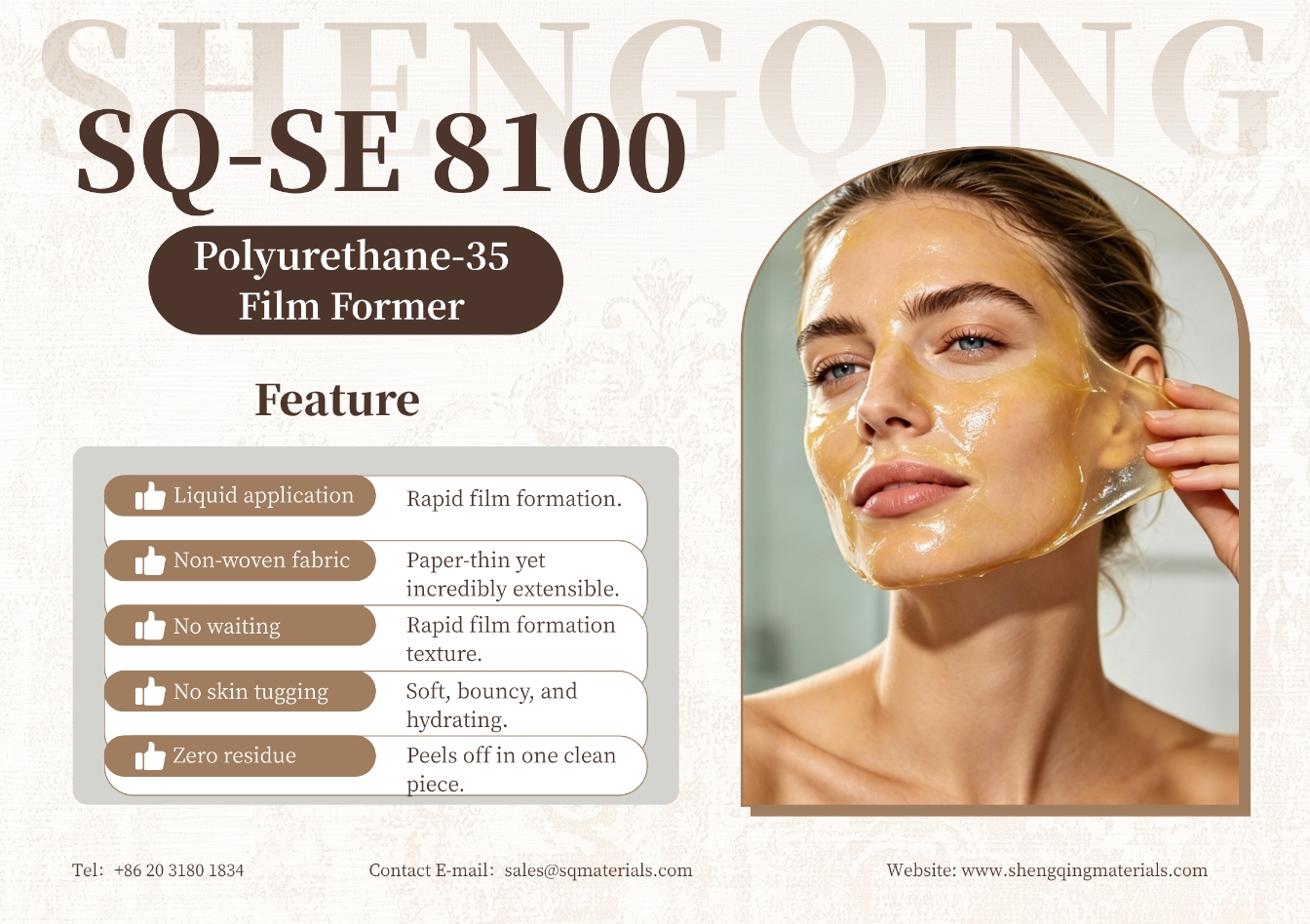
SQ-SE 8100, INCI name Polyurethane-35, is a high-performance film former specially developed for peel-off masks. It replaces PVA's rigid skeleton with polyurethane's flexible network — not an incremental improvement, but a complete reinvention.
SQ-SE 8100 (Polyurethane-35) forms a film that is soft, flexible, and breathable, with excellent sensory properties and water resistance, while also reducing formulation tackiness.
Five Ways SQ-SE 8100 Transforms the Peel-Off Experience
① Soft and elastic — peeling no longer means "peeling your skin"
SQ-SE 8100 forms a soft yet resilient film with moderate skin adhesion, and crucially, it does not adhere to hair. This means no more ripping out fine vellus hairs, no more tear-inducing pulling. SQ-SE 8100 (Polyurethane-35) transforms peeling from "harsh tearing" into "gentle peeling."
② Water-resistant and anti-migration — a film that stays intact
SQ-SE 8100 offers outstanding water resistance and anti-migration properties. The film remains unaffected by sebum and sweat during wear — it neither softens nor disintegrates, maintaining its integrity throughout. This directly ensures a smooth peeling process: one complete film, one single removal.
③ Cold-process compatible + optimal viscosity — maximum formulation freedom
SQ-SE 8100 supports cold processing — no heating required, protecting heat-sensitive actives while saving energy. With a solids content of 39-41% and viscosity ≤300 mPa·s at 25°C, it offers a balanced flow that formulators can easily adjust.
④ Film formation at 0°C, and a non-tacky skin feel
With a minimum film-forming temperature (MFFT) of 0°C, it rapidly forms a continuous, uniform film at room temperature. The dried film feels non-greasy and non-sticky — light and breathable. The pH falls between 7.0 and 9.0, neutral to mildly alkaline and skin-friendly.
⑤ Peels off in one clean piece — no residue
Combining all these advantages, SQ-SE 8100 delivers a soft, flexible, and intact peelable film. With a gentle lift, the entire mask comes off in one piece, leaving the skin smooth and residue-free.
It Goes Way Beyond Cleansing Masks
SQ-SE 8100 (Polyurethane-35) has applications far beyond peel-off masks. It's also well-suited for mascara, eyeliner (products that need to form a durable film without feeling sticky, and that need to be long-lasting yet easy to remove), and peel-off nail polish. One film former, multiple blockbuster categories.
Do Peel-Off Masks Have to Hurt?
The answer is clear: No.
It was always the wrong film former. PVA's time is over. SQ-SE 8100 (Polyurethane-35) isn't a small tweak — it's a fundamental rewrite of how film formers should work. From harsh tearing to gentle peeling. From pain to pleasure.
The next time you come across the words "peel-off mask," don't flinch. Just ask: is this film hard or soft? Because that one question tells you everything you need to know.