

How to Reduce Foam in Agrochemical SC Formulations
If you’ve ever worked on a suspension concentrate (SC) formulation, you already know: foam is a nuisance that doesn’t go away on its own. It shows up during grinding, persists through mixing, and messes with your filling line. Worse, it can affect how the product performs in the field.
In this article, we’ll walk through why SC formulations are so prone to foaming, what problems that foam actually causes, and — most importantly — how to choose an agrochemical defoamer for SC that works without complicating your recipe.
Why is foam so common in SC formulations?
Suspension concentrates are complex systems. You’ve got:
- Solid active ingredients milled down to micron sizes
- Dispersants and wetting agents to keep particles suspended
- Thickeners and anti-settling agents
- Sometimes glycols or other additives
Many of these components are surface-active. When you add mechanical energy — milling, pumping, stirring — air gets trapped. And because the liquid phase already contains surfactants, those air bubbles become stable foam.
In short: SC formulation chemistry + high-shear processing = foam is almost inevitable.
What problems does foam cause in suspension concentrates?
You might think foam is just an appearance issue. It’s not. Here’s what actually happens when foam gets out of control in an SC production line:
1. Reduced milling efficiency
Foam cushions the grinding media, so you need longer milling cycles to reach the target particle size. That means higher energy bills and slower throughput.
2. Inaccurate filling volumes
Foamy liquid doesn’t fill consistently. One bottle gets 480 ml, the next gets 520 ml. You either waste product or risk customer complaints.
3. Production bottlenecks
Foam overflows from tanks or recirculation lines. Operators have to slow down or stop to let foam settle. Scale-up becomes unpredictable.
4. Poor field performance
Foam in the spray tank leads to inconsistent application. Some nozzles get air pockets, others don’t. The result: uneven coverage and wasted agrochemical.
So yes, foam control is not a “nice to have”. It’s a cost and quality issue from the lab to the field.
Solutions: choosing the right defoamer type for SC
Not all defoamers work well in suspension concentrates. You need something that:
- Knocks down foam quickly during high-shear milling
- Doesn’t cause separation or oiling out over time
- Stays effective without re-foaming after standing
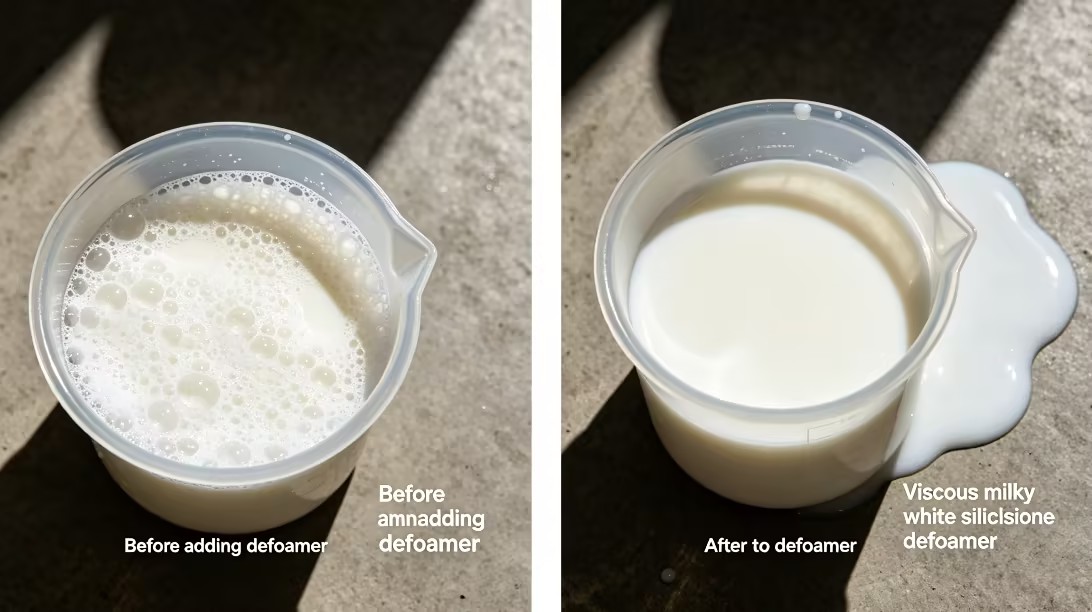
There are a few common types of defoamers used in agrochemical SC formulations:
|
Defoamer Type |
Pros |
Cons for SC |
|
Oil-based |
Cheap, strong knockdown |
Often separates, leaves oil spots |
|
Powder defoamers |
Easy to add dry |
Poor dispersion, may clog mills |
|
Silicone emulsions |
Stable, effective, compatible |
Quality varies by emulsion design |
Our silicone defoamers for SC formulations
We’ve developed three silicone-based defoamers specifically for crop protection manufacturing. Each one is designed for a different production setup, but all three share a focus on low dosage, reliable foam suppression, and formulation compatibility.
SQ-SF 30E — the standard choice for SC
- 30% active silicone emulsion
- Designed for suspension concentrate systems and high-shear environments
- Fast foam knockdown, stable emulsion structure
- Balanced cost-performance
SQ-SF 50E — higher solids, lower shipping cost
- 50% active content
- Same foam control performance as 30E
- Cuts transport and storage costs by almost half
- Ideal for high-volume manufacturing
Best for: Large-scale SC production where logistics matter.
SQ-SF 102 — for transparent water-based systems
- Not just for SC — but works well in low-viscosity transparent formulations
- Effective at ~200 ppm
- Long-lasting foam suppression
- Excellent compatibility
Not sure which one fits your process? Start with SQ-SF 30E — it’s the most versatile for suspension concentrates.
Want to see the full picture?
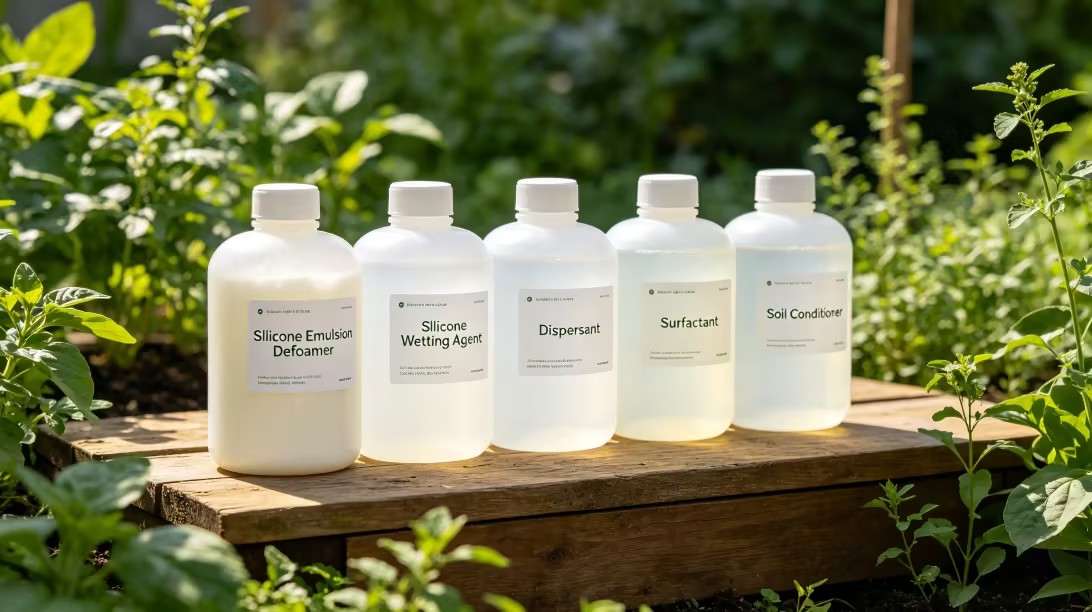
We’ve put together a complete product overview page that covers not only defoamers but also our full adjuvant portfolio: organosilicone wetting agents, dispersants, surfactants, and soil conditioners. If you formulate agrochemicals — whether SC, WG, WP, or liquid concentrates — that page will give you a clear view of what’s available and when to use each product. Click here to explore our full agrochemical adjuvant
Contact E-mail:sales@sqmaterials.com
Contact Phone:+86 20 3180 1834