

Does Your Laundry Scent Fade After Drying? What SENCHIN F Series Microencapsule Fragrance Changes
A Familiar Dilemma
You spend a year perfecting a laundry detergent—fragrance balance, stability, detergency, all passing with flying colours. Pre-launch consumer tests show high scores for open-bottle scent. Three months in, the reviews start appearing: “Smells great at first, but after two washes, there’s nothing left.” You know it’s not a formulation flaw. But consumers don‘t distinguish between formula and fragrance—they simply conclude “this product doesn’t work.”
The Problem Isn‘t the Formula—It’s How Fragrance Is Delivered
Conventional fragrances consist of dozens of volatile aromatic compounds. Top notes dissipate within minutes; middle notes are largely stripped away in the dryer. The fundamental conflict is this: the surfactants in your detergent are designed to remove oils—and fragrance is precisely that, an oil. Loss during processing. Loss through emulsification during washing. Loss through volatilisation during drying. By the time it reaches the consumer, the retention rate of the initial fragrance is typically below 20%.
Microencapsulation Changes the Retention Pathway
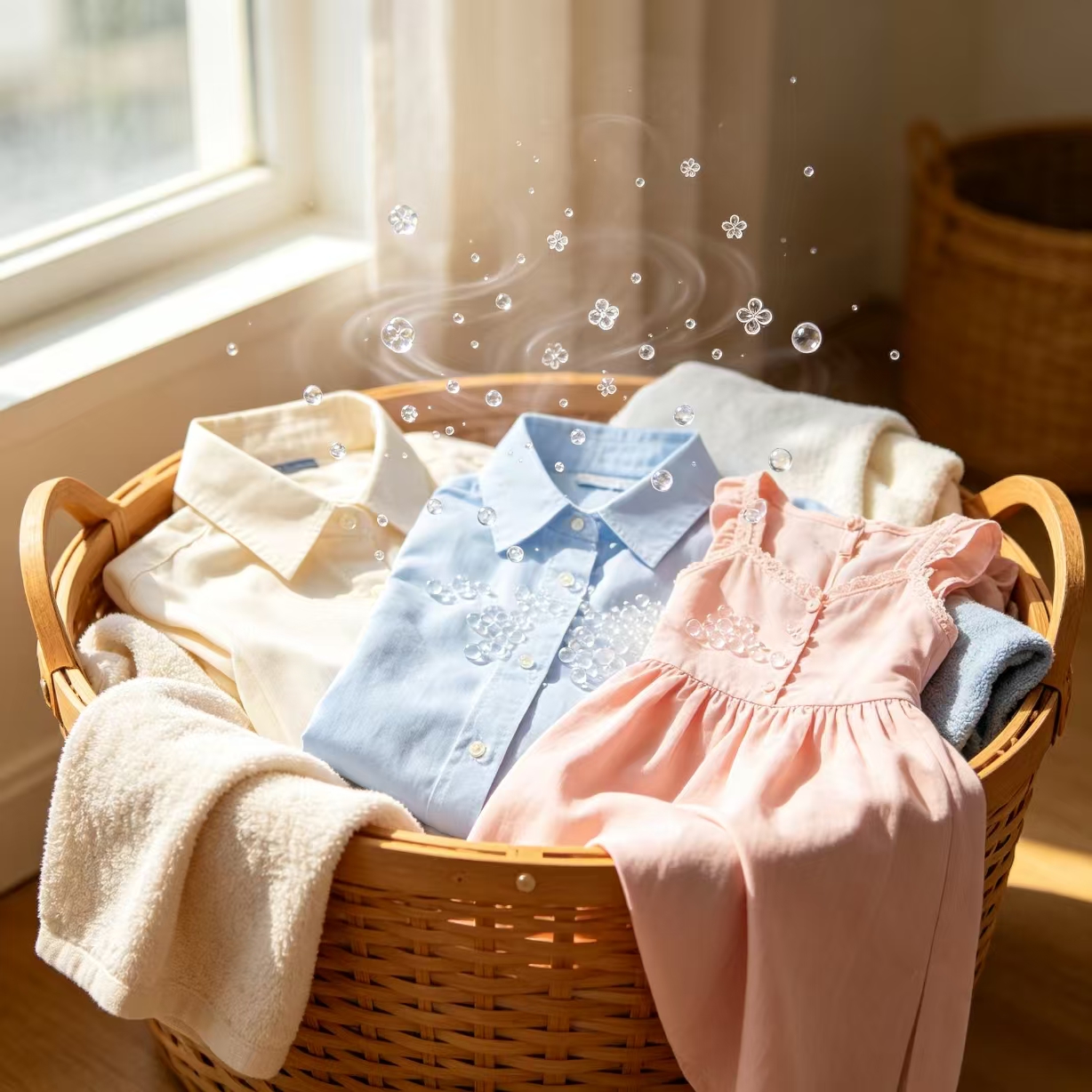
SENCHIN F Series uses microencapsulation technology to enclose fragrance oils inside a 5–30 μm polymer shell. These microcapsules do not evaporate actively; instead, they deposit onto fabric fibres during washing and remain in a “standby” state. When the consumer moves, rubs the fabric, or body temperature rises, some capsules rupture and release fresh fragrance. This is not sustained release—this is “on-demand” release. The scent appears only when it is needed, and it lasts for weeks. The product remains stable under standard warehousing conditions.
Three Verifiable Improvements
Compared to conventional liquid fragrance, SENCHIN F Series delivers quantifiable improvements in three dimensions:
1. Heat resistance. With a solid content of 25%–35% and a pH range of 6.0–8.0, it is directly compatible with mainstream detergent, softener, and textile-finishing systems. During high-shear mixing, spray drying, or heat-setting above 120°C, the microcapsule structure remains intact, physically shielding the fragrance—loss rates are significantly lower than those of unprotected liquid fragrance.
2. Scent duration extends from hours to weeks. Conventional fragrances largely lose their effect once the drying cycle ends, whereas microcapsules deposited on fibres continue to trigger release throughout subsequent storage and wear. Laboratory tests confirm that treated fabrics maintain a detectable fragrance intensity for several weeks.
3. Lower addition levels with higher retention rates. Recommended dosage is 0.5%–2% (on fabric weight) for textile treatments and 0.1%–2% (on total formulation) for household care products. Because the fragrance is anchored onto the fibre surface rather than dissolved in the wash liquor, consumers perceive a stronger and longer-lasting scent at the same or even lower dosage.

What This Means for Your Brand
Features converge, but experiences persist. Consumers will not remember your surfactant blend—they will remember “that softener that kept my clothes smelling great for a week.” In today‘s highly commoditised home-care market, long-lasting scent is not a nice-to-have marketing claim. It is the primary cue for consumers to judge “cleanliness” and “quality.” It is the starting point of repurchase and the basis for brand premium. What conventional fragrance cannot achieve, microcapsules can. And SENCHIN F Series makes this technology available to all brands—no exclusive barriers.
Six Variants Covering Mainstream Scent Preferences
SENCHIN F Series offers six differentiated fragrance variants covering fruity, floral, and coconut-milk directions, suitable for various brand positions and consumer segments:
- F100 Apple — fresh and crisp green apple scent, ideal for laundry products positioned around “clean freshness”;
- F110 Freesia — elegant and light white floral note, a natural choice for fabric softeners and premium textile care;
- F120 Bluebell — crisp, transparent green-floral with high distinctiveness, well-suited for products targeting younger consumers;
- F130 Ocean-Moistened Flower Shadows — an aquatic-floral blend that evokes the feeling of “line-dried by the sea”;
- F140 Coco— creamy coconut-milk note with a tropical warmth and gentle sweetness, suitable for family care, baby products, and “cozy home” positioning;
- F150 Peach — juicy, sweet fruity scent with broad appeal, suitable for family and baby care applications.
All six variants share the same microencapsulation technology platform, with consistent processing parameters and recommended dosage ranges. Brands can flexibly select or combine variants according to their target markets. Additional variants are under development – stay tuned.
We don’t know whether your competitors have already started evaluating microencapsulation technology. But here‘s what we do know: when it comes to scent retention, the first to complete validation wins a differentiated selling point that consumers actually remember. Samples of all six variants are ready. Data is verifiable. All that’s missing is your decision.